To the east of Groote Eylandt is what body of water?
| Native name: Ayangkidarrba | |
|---|---|
 Groote Eylandt from space, Nov 1989 | |
| Groote Eylandt Bear witness map of Northern Territory Groote Eylandt Show map of Australia | |
| Etymology | From the Dutch for "Large Island" |
| Geography | |
| Location | Gulf of Carpentaria |
| Coordinates | 13°58′S 136°35′E / 13.967°Due south 136.583°E / -xiii.967; 136.583 Coordinates: 13°58′S 136°35′E / thirteen.967°S 136.583°E / -13.967; 136.583 |
| Area | 2,326.i kmtwo (898.1 sq mi) |
| Length | 50 km (31 mi) |
| Width | 60 km (37 mi) |
| Highest elevation | 219 m (719 ft) |
| Highest point | Central Colina |
| Assistants | |
| Australia | |
| Territory | Northern Territory |
| Region | East Arnhem Region/ unincorporated Alyangula |
| Ward | Anindilyakwa Ward/ unincorporated Alyangula |
| Largest settlement | Alyangula (popular. 966) |
| Demographics | |
| Population | 2,811[1] (2016 census) |
| Pop. density | 1.21/km2 (3.13/sq mi) |
| Ethnic groups | Warnindhilyagwa |


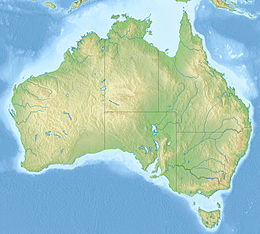
Groote Eylandt (Anindilyakwa: Ayangkidarrba meaning "isle" [2]) is the largest island in the Gulf of Carpentaria and the quaternary largest island in Commonwealth of australia. It was named by the explorer Abel Tasman in 1644 and is Dutch for "Large Island" in primitive spelling. The modern Dutch spelling is Groot Eiland.
The original inhabitants of Groote Eylandt are the Anindilyakwa, an Ancient Australian people, who speak the Anindilyakwa language (too known equally Amamalya Ayakwa). They consist of xiv association groups which make up the two moieties on the island. The clans maintain their traditions and have strong ties with the people in the customs of Numbulwar and on Bickerton Island. The island'due south population was 2,811 in the 2016 census.
In that location are four communities on Groote Eylandt. The mining company GEMCO established the township of Alyangula for its workers.[three] The iii main Aboriginal communities are Angurugu and Umbakumba, and Milyakburra on Bickerton Isle. There are also a number of outstations on the island.[iv]
The Anindilyakwa Land Council is one of four land councils in the Northern Territory. It is a representative body with statutory say-so under the Aboriginal State Rights (Northern Territory) Act 1976 and has responsibilities under the Native Title Act 1993 and the Pastoral Land Human activity 1992.
Geography [edit]
Groote Eylandt lies most 50 km (31 mi) from the Northern Territory mainland and eastern declension of Arnhem State, most 630 kilometres (390 mi) from Darwin, opposite Bluish Mud Bay. The island measures nearly 50 kilometres (31 mi) from east to w and 60 kilometres (37 mi) from northward to south; its area is 2,326.one km2 (898.1 sq mi). It is generally quite low-lying, with an average peak to a higher place sea level of xv metres (49 ft), although Central Loma reaches an elevation of 219 metres (719 ft).
Politics and Administration [edit]
Electorates [edit]
Groote Eylandt is part of the federal electorate of Lingiari,[5] for which the current member is Warren Snowdon.[half dozen] The island is within the Northern Territory electoral division of Arnhem. The current member for Arnhem is Labor Party member Selena Uibo,[7] whose mother is a Nunggubuyu and Anindilyakwa woman.
Local government [edit]
With Bickerton Island and a few smaller satellite islands, Groote Eylandt forms Anindilyakwa Ward of E Arnhem Region. It contains the communities of Angurugu, Alyangula, Umbakumba, Yadagba Commune, Uburamudja District and Sandy Hill (Groote Eylandt) and Milyakburra District (Bickerton Isle).[8]
Outside the local government, subdivision is the mining company GEMCO town of Alyangula, an unincorporated territory inside the Northern Region of Northern Territory.
Environs [edit]
The whole of Groote Eylandt and its surrounding waters prevarication inside the Anindilyakwa Indigenous Protected Expanse. BirdLife International has classified an unnamed islet off the northward-eastern coast as an important bird area because of its global importance every bit a roseate tern convenance site.[nine]
Groote Eylandt has a variety of habitats: dumbo stands on monsoon forests rising behind littoral sand dunes, alternating with mangrove and mudflats. Sandstone outcrops and laterite provide excellent niches for shellfish.[10]
Fishing [edit]
Until recently, the island had been open to the public only with permission, and the local Ancient Country Council did not encourage tourism. There is now a resort-style hotel on the island, and visitors are welcome. The island is condign renowned for its fine Aboriginal stone art sites, arts and crafts and outstanding sport-fishing, including sailfish, marlin, tuna, Spanish mackerel, giant trevally, queenfish, and coral trout.[11]
History [edit]

Traditional Owners [edit]
The traditional owners of Groote Eylandt, the Anindilyakwa people, take 14 clan groups, which make upward the 2 moieties on Groote Eylandt. The Anindilyakwa people take inhabited the island for thousands of years. The clans maintain their traditions and have potent ties with the people in the community of Numbulwar and on Bickerton Island.
In 1856, the Jurambunga tribe, a local aboriginal conglomerate would regularly pass the island.
Macassan Traders [edit]
There had been regular contact betwixt local Aboriginal people and Macassan traders who would visit the area searching for trepang from around the early to mid-1700s. They introduced culinary delights such as tamarinds, chilli and beer. The trade continued until the Australian Government introduced the White Australia Policy in 1906.
In that location is still evidence of the Macassans, such as the wild tamarind trees, which the traders introduced to the area. Some Groote Eylandt settlements, such equally Umbakumba, tin can trace their names back to Macassan origin.[12] [13]
Machado-Joseph Disease (MJD) [edit]
The commencement recorded European sighting of Groote Eylandt was in 1623, by the Dutch ship Arnhem, nether Willem van Coolsteerdt. However, the relative prevalence of the hereditary Machado-Joseph Illness (MJD) in the Groote Eylandt customs (a condition otherwise mainly found in the Azores) was previously suggested as show of early contact with Portuguese sailors. (Contact with Chinese traders has also been suggested as a cause.[fourteen]) Contempo genetic studies showed that the Groote Eylandt families with MJD shared a haplogroup with some families from Taiwanese, Indian, and Japanese families.[15]
European Colonisation [edit]
Church Mission Society [edit]
The showtime European settlement on the isle was a Christian mission established by the Church Missionary Society at Emerald River in 1921. In 1943, afterwards a cyclone swept through the mission, CMS decided to move the settlement s of the Angurugu River. The local Anindilyakwa people called the called location "Mungwardinamanja". However, every bit it was difficult for the European missionaries to pronounce, the local Anindilyakwa men guiding them chose the name of the Angurugu River mouth "Angurrkwa", which was later on Anglicised to Angurugu.[16]
Umbakumba [edit]
Mr Fred H. Gray, a pearl and trepang trader, established the Umbakumba Native Settlement on an old Macassan trading post in 1938. The place-name itself Umbakumba comes from the Malay give-and-take ombak-ombak, which means 'lapping of waves'. He used the settlement as a base for trepanging and employed many of the Ancient locals during the 20s and 30s.
World State of war Two [edit]
During World State of war Ii, in 1943, the mission moved to Angurugu, equally the RAAF required the use of the mission'southward airstrip: the ruins of the RAAF base are still evident today. Qantas used the island every bit a flight boat base.
Following the Aboriginal State Rights (Northern Territory) Act 1976, Groote Eylandt was converted to Aboriginal freehold title land. In 1979, control of the island was transferred to the local Aboriginal Town Council.
Mining [edit]
The majority of Commonwealth of australia's manganese reserves are located on the western side of Groote Eylandt.[17] Special mining leases were granted to the Groote Eylandt Mining Visitor (GEMCO), a wholly-owned subsidiary of the BHP but has become a part of South32 since eighteen May 2015.[18]
GEMCO has been operating a big manganese mine near the customs of Angurugu since the 25th July 1964. The mine produces more than iii.viii million tonnes annually – nigh a quarter of the globe's full. Mining rights are renewed every 21 years, with operations expected to go along until 2027.[nineteen]
Groote Eylandt Mining Company (GEMCO) established the town of Alyangula as the residence for the mining company workers in the late 1960s.[twenty]
Present-day [edit]
On May twenty, 2008, the federal authorities signed a deal with local Aboriginal people from Groote Eylandt to lease state to the government for 40 years. In render, the regime will spend coin in the community to improve housing, education, and health in the area.
Notable people [edit]
- Donald Thomson (1901–1970), Australian anthropologist and biologist.
- David Warren (1925–2010), inventor of the flying data recorder, built-in on Groote Eylandt.
- Nick Kenny (1982–), former Brisbane Broncos rugby league player who moved to Groote Eylandt.[21]
- Norman Tindale (1900–1993), Australian anthropologist, archeologist, entomologist and ethnologist.
- Emily Wurramara, singer-songwriter, born on the island.
- Kaye Aldenhoven, a poet who lived and taught on the island
See too [edit]
- Groote Eylandt Airport
- List of islands of Australia
References [edit]
- ^ "Anindilyakwa (SA2) (702041062)". stat.abs.gov.au. Australian Agency of Statistics. Archived from the original on 31 December 2017. Retrieved 29 October 2017.
- ^ Wells, J.C. (2008). Longman Pronunciation Lexicon. Pearson Longman. ISBN9781405881173.
- ^ "Groote Eylandt and Bickerton Island Regional Partnership Agreement" (PDF).
{{cite web}}: CS1 maint: url-status (link) - ^ "Communities". Anindilyakwa Land Council . Retrieved 13 December 2021.
- ^ "Map of Commonwealth Electoral Partitioning of Lingiari" (PDF). Australian Electoral Commission. 2007. Retrieved 21 May 2009.
- ^ "The Hon Warren Snowdon MP". Parliament of Australia. Retrieved twenty November 2013.
- ^ Authorities, Northern Territory (22 November 2021). "Hon Selena Uibo". parliament.nt.gov.au . Retrieved 13 Dec 2021.
- ^ APH.gov.au Archived 2011-06-05 at the Wayback Machine
- ^ BirdLife International. (2011). Of import Bird Areas factsheet: Islet off NE Grooyte Eylandt. Downloaded from http://www.birdlife.org on 2011-07-thirteen.
- ^ Waddy 1986, p. 149. sfn error: no target: CITEREFWaddy1986 (help)
- ^ "Groote Eylandt Fish". world wide web.grootefishing.com.au . Retrieved 24 March 2016.
- ^ Cooper, D. "Name change for school", Ayakwa, June/July 2012, p. nineteen.
- ^ Van Egmond, M-Due east. (2012). "Enindhilyakwa phonology, morphosyntax and genetic position." Doctoral thesis. Academy of Sydney. pp. 314–seventy.
- ^ Palin, Megan (x November 2016). "'Cruel, mortiferous affliction' on idyllic Aussie island: 'Now nosotros're seeing teens in wheelchairs'". News.com.au — Australia's Leading News Site.
- ^ Martins, Sandra & Bing-Wen Soong (2012). "Mutational Origin of Machado-Joseph Illness in the Australian Aboriginal Communities of Groote Eylandt and Yirrkala". Archives of Neurology. 69 (half-dozen): 746–751. doi:ten.1001/archneurol.2011.2504. PMID 22351852.
- ^ Rademaker, Laura. "Linguistic communication and Australian Aboriginal History; Anindilyakwa and English on Groote Eylandt" (PDF). Australian National University: half-dozen.
- ^ Langkamp, Peter John (1978). Studies on the rehabilitation of mined areas on Groote Eylandt (Northern Territory). Academy of Melbourne.
- ^ Access to Official List Australian Securities Exchange xviii May 2015
- ^ McCulloch 2016. sfn error: no target: CITEREFMcCulloch2016 (aid)
- ^ "Groote Eylandt and Bickerton Island Regional Partnership Agreement: Progress Evaluation" (PDF). Department of Social Services. Commonwealth of Australia. May 2012. Retrieved 3 May 2015.
- ^ "Nick Kenny lands on Groote Eylandt" (PDF). Eylandt Repeat. 15 February 2011. p. five. Retrieved six April 2015.
External links [edit]
- Alyangula Expanse School
- Alyangula Area School
- Angurugu Community Government Quango site
- Eastward Arnhem Regional Council
- Eylandt Echo
- GEMCO – The Groote Eylandt mining company
- GEMCO publication with map
Source: https://en.wikipedia.org/wiki/Groote_Eylandt

Post a Comment for "To the east of Groote Eylandt is what body of water?"